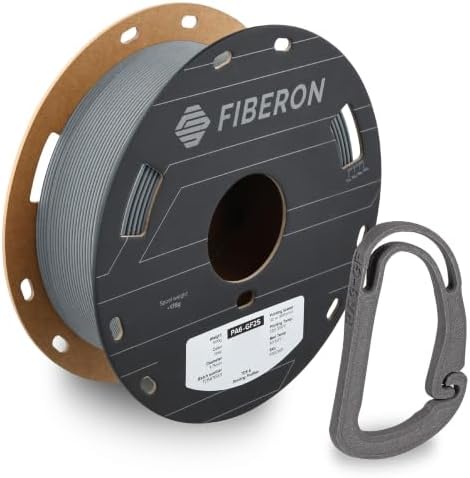
Polymaker Fiberon PA6-GF25 Glass Fiber Nylon Filament 1.75mm, Grey, 0.5kg
Is this a good price? Every Thursday we email the cheapest price per kg for each major material, plus our best buy of the week.
Product Details
- Strong Nylon for Load-Bearing Parts: PA6-GF25 combines 25% glass fiber reinforcement with Nylon 6 to provide high strength, stiffness, impact durability, and layer adhesion for brackets, housings, jigs, fixtures, automotive components, and mechanical parts.
- Engineered Heat Performance: After annealing at 100°C for 16 hours, test specimens reach an HDT of 191°C at 0.45 MPa and 157°C at 1.8 MPa. These results are not continuous-use temperature ratings; actual performance depends on load, geometry, moisture, print orientation, and processing conditions.
- Keep Dry Before and During Printing: Nylon 6 absorbs moisture, which can reduce stiffness and strength while increasing flexibility. Store and print below 20% relative humidity. If exposed to moisture, dry at 100°C for 10 hours and print directly from a dry box when possible.
- Use an All-Metal Hotend and Hardened Nozzle: Print at 280–300°C with a 40–50°C build plate and the cooling fan off. Do not exceed the recommended bed temperature, as excessive heat may increase warping. A heated chamber is not required. Speeds up to 300mm/s are possible after calibration.
- Important Post-Printing Guidance: Anneal printed parts at 100°C for 16 hours when maximum thermal and mechanical performance is required. Remove same-material supports before the part absorbs excessive moisture, as the supports may become difficult to separate. Validate dimensions after annealing.
From the listing on Amazon.
View our other Polymaker listings here.
View our other Nylon-GF listings here.
Keep your filament dry, view our gear here.
Printing Polymaker Nylon-GF
Polymaker Nylon-GF in Grey is Nylon filled with chopped glass fiber, and this listing is a 0.5kg spool. The fibers make parts stiffer and more dimensionally stable than plain Nylon, but they are abrasive, so a hardened nozzle is mandatory (see nozzle compatibility below). The ranges below are for Nylon-GF, which usually prints a little hotter than plain Nylon. Nylon-GF is best suited to stiff, heat-tolerant parts that need to hold up to impact. Brands and even individual spools vary, so treat these as starting points and run a quick temperature tower to lock in the sweet spot for your printer.
Ranges checked against Bambu Lab data. Heat resistance is the heat deflection temperature (HDT). Read our glass fiber filament guide for bed adhesion, drying, troubleshooting, and material-specific tips.
Nozzle Compatibility
Glass fiber is abrasive and wears brass (and stainless) nozzles out of round, sometimes within a single spool. Use hardened steel or another wear resistant nozzle such as ruby or tungsten carbide. With hardened steel, start about 5 to 10°C hotter than you would with brass.
Based on Bambu Lab and Prusa guidance. More in our glass fiber filament guide and nozzle types guide.