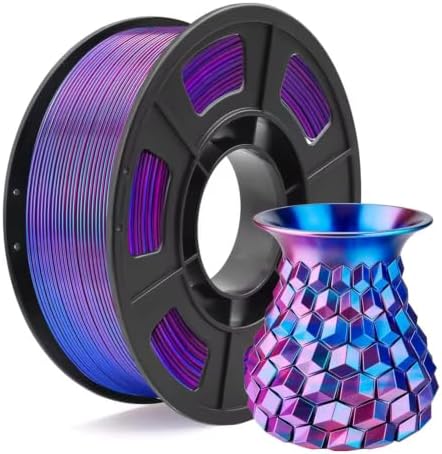
ANTINSKY Silk PLA Filament 1.75mm 250g, Blue Purple Dual Color, 3D Printer | No mid-print filament swaps; diameter tolerance ±0.03mm; nozzle 200–230°C; bed 40–60°C; speed 50–80mm/s; dry storage
Is this a good price? Every Thursday we email the cheapest price per kg for each major material, plus our best buy of the week.
Product Details
- Two colors in one strand: Blue and purple run together in the same filament, creating a two-tone effect without changing filament during the print or manually swapping colors between layers.
- Silk surface finish: A soft sheen and smooth-looking layer lines suit display models, organizers, decorative pieces and vase-mode prints where appearance matters.
- 1.75 mm diameter with ±0.03 mm tolerance: Consistent filament diameter supports smooth feeding and controlled extrusion on common 1.75 mm FDM printers.
- Recommended printing settings: Nozzle 200–230°C, heated bed 40–60°C and speed 50–80 mm/s. For an unheated bed, apply a glue stick or suitable bed adhesive to support first-layer adhesion.
- 250 g spool and dry storage: Supplied on a cardboard-sided spool. Keep sealed and dry, away from direct sunlight and moisture. Store opened PLA in a dry box or sealed bag between prints.
From the listing on Amazon.
View our other Antinsky listings here.
View our other PLA listings here.
Keep your filament dry, view our gear here.
Printing Antinsky PLA
Antinsky PLA in Silk Blue runs on the PLA profile below, and this listing is a 0.25kg spool. PLA is best suited to everyday prototypes, models, and indoor parts that won't face heat or heavy stress. Brands and even individual spools vary, so treat these as starting points and run a quick temperature tower to lock in the sweet spot for your printer.
Ranges checked against Bambu Lab, Prusament and Polymaker data. Heat resistance is the heat deflection temperature (HDT). Read our PLA filament guide for bed adhesion, drying, troubleshooting, and material-specific tips.
Nozzle Compatibility
This is an unfilled plastic, so it is not abrasive: a brass nozzle works and lasts, and so does hardened steel. With hardened steel, print about 5 to 10°C hotter.
Based on Bambu Lab and Prusa guidance. More in our nozzle types guide.