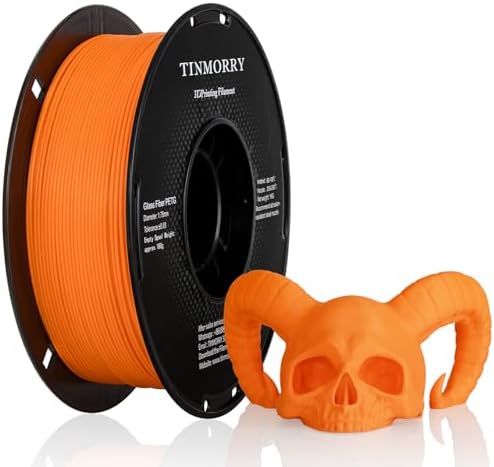
TINMORRY PETG-GF Glass Fiber PETG Filament 1.75mm, 1 KG, Frosted Orange | Glass Fiber Reinforced PETG, High Rigidity & Durability, Low Warping, Heat & Chemical Resistance, Frosted Finish
Compare all 21 TINMORRY PETG-GF 1kg listings →
Is this a good price? Every Thursday we email the cheapest price per kg for each major material, plus our best buy of the week.
Product Details
- Printing Tips: 1. Dry before use for the highest print quality (65 °C, 8 h). Printing and Keeping Container's Humidity < 20% RH (Sealed, with Desiccant). 2. Recommend Nozzle Temp 260℃, Temp tower test and flow calibration required when use. Bed Temp: 80℃ , Print Speed: <250 mm/s. 3. Please use wear-resistant steel nozzles ( 0.6 mm is recommended, 0.4mm Capable) instead of ordinary brass nozzles! 4. Perfectly compatible with Bambu Lab FDM 3D Printers.
- Dimensional Stability & Premium Frosted Surface: With a dimensional accuracy of 1.75 ±0.03mm, TINMORRY PETG-GF 3D printing filament has a glass fiber reinforcement that minimises warpage and shrinkage compared to regular PETG filament, providing unparalleled dimensional stability while giving the print a frosted surface texture.
- Superior Mechanical Performance:The addition of glass fiber significantly improves the mechanical properties of the printed parts. TINMORRY PETG-GF 3D printer filament offers increased rigidity and durability compared to regular PETG filament.Making it suitable for rigid structural and technical components.
- Excellent Heat & Chemical Resistance: TINMORRY PETG-GF filament offers excellent heat resistance, making it suitable for printing models with high temperature requirements.Compared to ordinary PLA filament, PETG-GF filament has superior chemical resistance to ensure long-term performance in challenging environments.
- Multiple Colors & Wide Application:One of the advantages of glass fiber reinforcement is that it is easier to produce a wider range of colors than carbon fiber PETG. TINMORRY glass fiber PETG filament is very strong and durable with excellent heat resistance, which makes it suitable for printing parts with high temperature and load-bearing requirements, Such as: automotive decorative parts, sports protective equipment, electrical applications, outdoor applications, drone frames, etc.
From the listing on Amazon.
View our other TINMORRY listings here.
View our other PETG-GF listings here.
Keep your filament dry, view our gear here.
Printing TINMORRY PETG-GF
TINMORRY PETG-GF in Orange is PETG filled with chopped glass fiber, and this listing is a 1kg spool. The fibers make parts stiffer and more dimensionally stable than plain PETG, but they are abrasive, so a hardened nozzle is mandatory (see nozzle compatibility below). The ranges below are for PETG-GF, which usually prints a little hotter than plain PETG. PETG-GF is best suited to stiff, stable functional parts that handle knocks better than carbon fiber grades. Brands and even individual spools vary, so treat these as starting points and run a quick temperature tower to lock in the sweet spot for your printer.
Ranges checked against Elegoo data. Heat resistance is the heat deflection temperature (HDT). Read our glass fiber filament guide for bed adhesion, drying, troubleshooting, and material-specific tips.
Nozzle Compatibility
Glass fiber is abrasive and wears brass (and stainless) nozzles out of round, sometimes within a single spool. Use hardened steel or another wear resistant nozzle such as ruby or tungsten carbide. With hardened steel, start about 5 to 10°C hotter than you would with brass.
Based on Bambu Lab and Prusa guidance. More in our glass fiber filament guide and nozzle types guide.